highres.jpg)




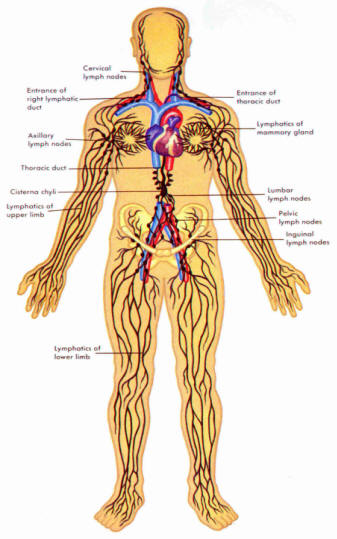
Your lymphatic system plays a large role in immune function and circulation.
It consists of lymph vessels located just under the skin, meeting up with lymph nodes located in your neck, armpits, and groin area. As the lymph vessels move fluid out of the tissues, waste products, bacteria, dead cells, and large protein molecules are collected. The waste products are carried to the lymph nodes to be broken down and eliminated, while the protein rich fluid is transported back to the heart to rejoin circulation.
When the lymph vessels are unable to transport lymph fluid back into circulation it accumulates, resulting in swelling and thickening of the skin. This build-up of protein-rich lymph fluid is known as lymphedema. Once this condition occurs, the swelling may increase if an effective treatment program is not initiated.
Lymphedema most often develops in one arm or leg, but may be present in both arms and both legs. It may also occur in the hands or feet, and even in the chest, back, neck, face, abdomen, and genitals.
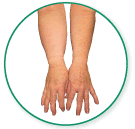 Primary Lymphedema is caused by malformations of the lymphatic system. These malformations are most common in women. They may be present at birth or may develop later, often during puberty or pregnancy. Primary lymphedema is most common in the legs, but may also occur in the arms or torso.
Secondary Lymphedema is a result of damage to the lymphatic system. Surgical procedures such as mastectomies, lumpectomies with radiation and/or removal of lymph nodes are the most common causes. Secondary lymphedema occurs most commonly in the arms, but may also develop in the legs. Other causes may include a traumatic injury, infection, or severe chronic venous insufficiency.
Lymphedema may develop within a few months after a procedure, years later, or not at all. The first obvious sign of lymphedema is swelling characterized by "pitting". This is recognizable when the skin is depressed for a few seconds and the indentation does not immediately disappear. Other symptoms may include a tightness or heaviness in the affected area or changes in the texture of the skin. You may even notice that jewelry and clothing feel tighter.
Lymphedema is not a temporary or self-correcting condition, waiting never helps. See a medical professional in order to stop the swelling as soon as possible. The sooner you address the problem, the sooner your limbs can return to normal size.
If your lymphatic system is compromised, this area of the body will have to work much harder to circulate fluid. When it is unable to keep up, swelling and fluid build-up are likely to occur. That is why lymphatic vessels in the compromised area need external support.
To control the swelling, your doctor or therapist may start by manually removing the fluids from the affected areas with his or her hands. (See the Article: Manual Compression Therapy for more information).
To keep the fluid out, they may then wrap the affected area in bandages. (See the Article:How do Bandages Work for more information). Without some kind of compression on your limb, the swelling will reoccur. Your therapist will probably measure you for compression garments to maintain your lymphatic health.
Next - See the Article: Why Medical Compression Garments Work
Juzousa.com and John Wellum, CPD
*Important: We are smarter than to try to practice medicine without a license! The information presented on this site is for informational purposes only. New medical information is available weekly - so check with your doctor and therapist before making any changes to your treatment!
LympheDivas fashion armsleeves and gauntlets are now available in dozens of new patterns!


 239-213-9458
 info@medicalstockingsonline.com


 Email store
 Checkout
 View Order Status